
From Empty Data to Full Clarity: How a Digital Twin Transformed Meow Wolf Los Angeles
- Leo Salce, Principal

- Apr 17
- 3 min read
Updated: 3 days ago

When a project begins without reliable information, every decision becomes a risk.
That was the starting point for the transformation of the Meow Wolf Los Angeles venue—an ambitious conversion of a former cinema and mall space into a fully immersive experience. While the vision was bold, the reality on the ground presented a fundamental challenge: there were no accurate as-built records of the building. No reliable drawings. No verified data. Just a complex, multi-level structure waiting to be understood.
And in a project where multiple design teams depend on precision, that’s not just an inconvenience—it’s a critical bottleneck.
The Real Challenge: Designing Without Knowing
Imagine trying to redesign a 41,000-square-foot space without knowing exactly what’s behind the walls, above the ceilings, or embedded within the structure.
That was the situation faced by the design team. The building featured curved geometries, multi-level atriums, exposed structural elements, and dense MEP systems—all of which needed to be accurately documented before any meaningful design work could begin.
Traditional surveying methods simply wouldn’t be enough. The project required something more robust, more precise, and more scalable.
It required a complete digital foundation.
Turning Reality into Data: The Scan to BIM Approach
Avant Leap approached the challenge with a clear objective: transform an undocumented building into a fully usable, multi-discipline digital twin.
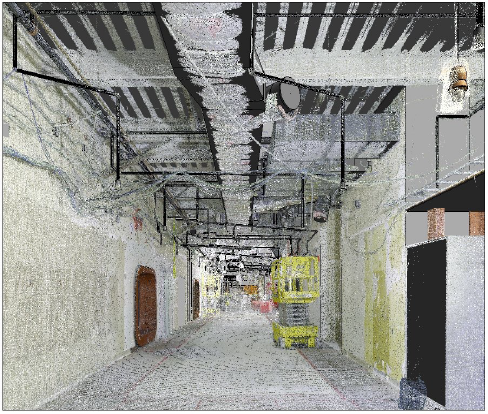
The process began with high-precision 3D laser scanning, capturing the entire interior space in extraordinary detail. Using advanced scanning technology, the team generated a dense, colorized point cloud—a digital representation of the building accurate down to millimeters.
But raw data is only the beginning.
From that point cloud, the team developed a coordinated BIM model across architecture, structure, and MEP systems. Every major element—from walls and ceilings to ductwork, piping, and electrical systems—was translated into a structured, intelligent model ready for real-world use.
What previously existed as uncertainty became something far more valuable:
-- A single, reliable source of truth for the entire project team.

From Complexity to Confidence
With the digital twin in place, everything changed.
Design teams could now work with confidence, knowing they were building on verified conditions. Coordination improved. Risk decreased. Decisions accelerated.
Instead of reacting to unknowns, teams could move forward proactively—aligning architecture, engineering, and systems from the very beginning.
And perhaps most importantly, the project stayed on schedule.
What could have easily turned into delays, rework, and costly surprises was instead delivered within a tight timeline—thanks to having the right data, at the right time, in the right format.
More Than a Model: A Long-Term Asset
The impact of this work didn’t end with the initial design phase.
The digital twin created for the Meow Wolf Los Angeles project is now a long-term asset—something that can be reused throughout construction, future renovations, and ongoing operations.
It’s not just documentation.
It’s a living, evolving representation of the building—one that continues to deliver value well beyond the initial scope.
What This Means for AECO Teams
This project highlights a reality many AECO organizations are already experiencing:
The challenge is no longer access to technology. It’s knowing how to apply it in ways that eliminate uncertainty and accelerate execution.
When teams operate without reliable data, everything slows down. When they have clarity, everything changes.
Want to See the Full Case Study?
This article only scratches the surface.
If you’d like to explore the full breakdown—including workflow details, deliverables, and measurable impact—you can download the complete case study here:
At Avant Leap, we don’t just build models.
We build the foundation that allows complex projects to move forward—with clarity, confidence, and precision. And in environments where complexity is the norm, that foundation makes all the difference.


Comments